

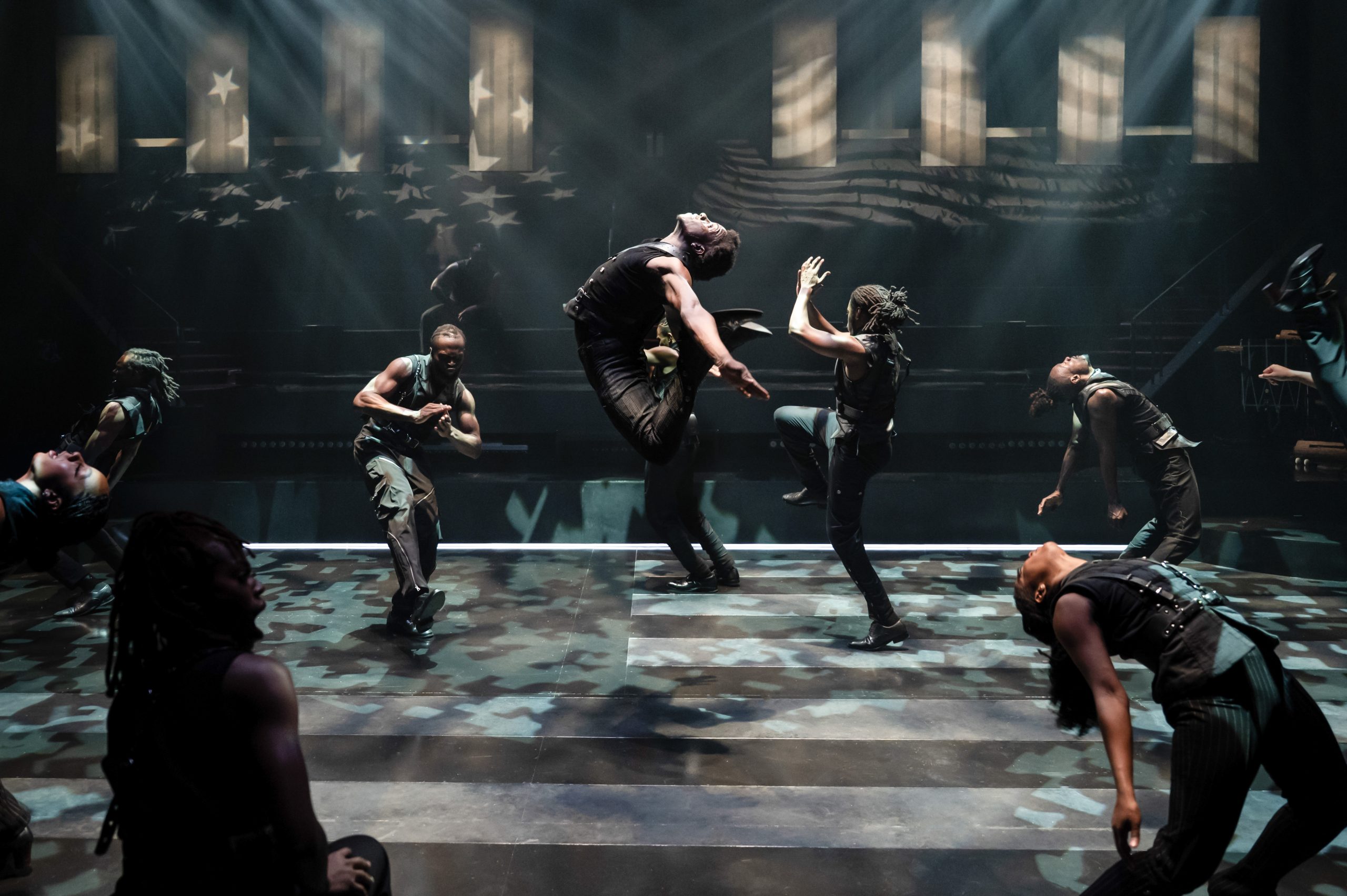
Entering Step Afrika!’s The Fruits of Our Labor performance space is like stepping into the ruins of Tara. Much like the antebellum mansion from Gone with the Wind, it has been ravaged by a fire. Rope, fabric and invasive vines dangle from the ceiling. Panels of the American flag, drained of their color to a smoky grayness, are displayed throughout the space. While the visible ropes are not overtly fashioned into nooses, our collective memories make the connection to lynching, a great American pastime.
The performers, all in almost unimaginably top physical shape, are dressed in that form-clinging black. The costuming evokes both the formal sobriety of mourning and the confrontational aggressiveness of the US Space Force Service Dress Uniform.
Many are used to the joyful exuberance of Step Afrika!’s winter holiday shows. With The Fruits of Our Labor, mounted in recognition of America’s 250th birthday, the company turns its attention to America’s history. The narrative is both sobering and rousing.
The Fruits of Our Labor is technically astounding. However, it goes further, overtly reclaiming the prophetic function of theater. Describing the damnable American situation, it raises questions to help center our thinking.
The text of a seminal sermon from the African American Baptist tradition, titled “The Eagle Stirreth,” debuts early in the show. This sermon and its metaphors are subsequently incorporated into the choreography. It is cast as a framework for the show’s exploration of American history.
In the sermon, the relationship between God and humanity is compared to an eagle “teaching her newly fledged offspring to fly.” Dropping her offspring in the air, she swoops down to rescue them if needed.
Choreographer Jakari Sherman takes the words of the sermon seriously. Using the grammar of dance, she rigorously portrays and dissects the parable of a people who, instead of blaming God for their predicament. They take responsibility for themselves, creating the disaster rooted in their own neglect of society’s spiritual underpinnings.
Americans must identify themselves as a “WE,” the production insists.

“We” is the most important word in the Constitution,” the performers note. “We” don’t know what to do.”
The production examines America’s 250-year history through the lens of Black folks, who are portrayed as a force consistently bending America towards justice. Where WE have come from? Where WE have failed? What WE are called to do?
The Fruits of Our Labor concludes without leaving patrons in despair.
See this production! Think about seeing it a second time before winter.
Directed and choreographed by Jakari Sherman with Conrad R. Kelly II and Vusi Mdoyi, The Fruits of Our Labor runs for approximately 80 minutes without intermission.
Gregory Ford is the Anacostia Coordinating Council Arts & Culture Critic. He is also an actor and singer. He is a member of the Verbal Gymnastics Playback Theater troupe. He has written for Capital Community News and continues to write for dctheaterarts.org, focusing on College and University Theater Productions. He is a clinical psychodrama practitioner. Ford lives in the Northeast Boundary in Ward 7.


