


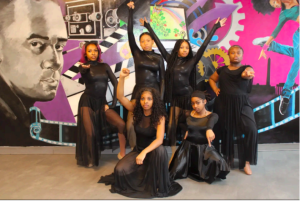
The dance team at Richard Wright Public Charter Schools for Journalism and Media Arts (475 School St. SW) performed an interpretive piece in February to honor Black History Month. “These students performed beautifully, demonstrating their charisma, flexibility and creativity,” wrote fellow student Jamari Tyree in the school’s student newspaper.
Later that month, the team won first place at the Reach the Beach National Championship in Ocean City, Maryland — a performance that linked history, creativity and competition.
On any given afternoon across the District, students at Washington’s public charter and private schools spill out of classrooms into gyms, music rooms and makeshift robotics labs. For many families, those hours after the last bell matter as much as algebra or English — a time when students learn leadership, collaboration, resilience and a sense of belonging.
Researchers and local advocates say these experiences are not just “extras,” but a core part of what keeps students connected to school and on track for college, careers and adulthood. That makes extracurricular activities — from athletics to arts, debate and robotics — a quiet but critical equity issue in the District’s education landscape.
An Extension of the Mission
DC’s 69 public charter networks often highlight extracurriculars as part of their appeal to families seeking more than traditional academics.
At Richard Wright PCS, Outreach Director Helen Compton-Harris estimates that about half of students participate in at least one club or team. All extracurricular activities originate with students, she said, reflecting their interests. This year, scholars asked to form a tennis team, while a video gaming club emerged as a social space built around shared interests.
Richard Wright treats extracurriculars as an extension of its academic mission, which focuses on preparing students in grades 8 through 12 to become skilled media creators. “These kinds of clubs and sports are essential to our culture and to learning new skills,” Compton-Harris said. “All of these clubs are really related to our mission.”
Other charter schools across the city take a similar approach. At Center City Public Charter School’s Congress Heights campus, students can choose from foreign language, drama, drum line, choir, robotics and sports. School leaders describe the offerings as a way to help students develop socially, emotionally and physically, particularly for families without access to private lessons or fee-based programs outside school hours.
Friendship Collegiate Academy in Northeast combines an award-winning robotics team and drama club with a highly ranked football program. School leaders say these activities reinforce values such as confidence, persistence and teamwork, preparing students to succeed in future academic and professional settings.
Charter leaders argue that this breadth reflects the sector’s founding purpose: to offer innovative educational programs designed to meet varied student interests, learning styles and life circumstances, according to the DC Public Charter School Board.
The “Whole Child”
Private schools across the District similarly place extracurriculars at the center of their educational models, often framing them as essential to “whole child” development. Leaders describe these programs as spaces where students learn to collaborate, take risks and explore identity in ways that mirror college and professional environments.
Holton-Arms, an independent girls’ school in Northwest, describes its approach as educating “not only the mind, but the soul and spirit,” with strong offerings in arts, athletics, health and global competencies. At Maret School, a K–12 independent school near Woodley Park, students are encouraged to balance rigorous coursework with creative and athletic outlets as part of a college-preparatory environment.
National Cathedral School promotes a campus “full of purposeful activity and engagement of the body, mind and soul,” where arts and athletics are woven into daily life. Sidwell Friends similarly emphasizes a wide range of student-led clubs, arts and athletics as central to its mission.
Sidwell Friends offers more than 65 clubs and extracurricular activities, from teacher-sponsored middle school options such as Robotics, Math Counts and language clubs (Chinese Culture Club, Heritage Spanish Speakers Club, Robotics, Math Counts, Animal Welfare Club) to student-run upper school groups focused on social justice and affinity spaces (Black Student Union, GLSBT, Asian Students Association) to microfinance, chess, political publications and performing arts.
At the high school level, extracurriculars are required. In Horizons, the school paper, Sidwell sophomore Angie Spadafora noted that every high school student must earn ten credit hours through athletics. The school also has a student-run booster club for athletic events, known as “The Fan.” Sidwell’s sports teams regularly win AA DC State Championships.
Sidwell Chief Communications Officer Bill Burger said the requirement for athletic participation is especially important today, as device use contributes to increasingly sedentary lifestyles. “In addition to helping students develop active habits, we believe team sports provide opportunities to build self-confidence, appreciate collaboration and develop skills students may use throughout their lives,” Burger said.

Students see benefits beyond fitness or competition. “It’s not just exercising — it’s learning to be on a team,” said a Sidwell eighth grader. “Being on a sports team helps me use those skills and apply it to the classroom.”
Research-Backed Benefits
Research broadly supports these claims. Studies consistently show that adolescents who participate in extracurricular activities earn higher grades, attend school more regularly and report stronger social and emotional development than peers who do not. Longitudinal research also links sustained participation to higher rates of college enrollment and persistence, particularly for low-income students.
Research on arts, athletics and afterschool programs further ties participation to improved school engagement, social skills and overall well-being. National evaluations of federally funded afterschool programs find that most students say clubs and activities help them academically and make them like school more.
Meta-analyses summarized by CASEL similarly conclude that programs building skills such as self-management and relationship-building are associated with academic gains and improved long-term outcomes. For many DC families — especially in neighborhoods with fewer enrichment options — afterschool programs also provide a safe place for students while parents work, along with a network of adults who know their children well.
Gaps in the System
Despite strong evidence of benefits, access to extracurriculars and afterschool programming in DC remains uneven.
A January 2025 policy snapshot from DC Action estimates that about 37,000 public school students participate in afterschool programs citywide, while roughly 53,000 lack access. A poll of DC parents found that for every child enrolled in an afterschool program, another is waiting for a spot.
Those figures span DC Public Schools, public charters and community-based programs, and reflect barriers such as limited capacity, transportation challenges and fees.
The Office of the State Superintendent of Education helps fund afterschool programming through 21st Century Community Learning Centers grants, which support academic enrichment and social-emotional development in high-need communities. In DC, those funds flow to school districts, charter networks and nonprofits.
Even so, advocates say funding falls short of demand. Many programs maintain waitlists, and some schools offer only a limited range of clubs — or none at all — due to staffing, space or cost constraints.
More Than “Nice to Have”
The stakes could rise further if federal lawmakers reduce support for afterschool programs.
The 21st Century Community Learning Centers initiative — the nation’s only dedicated federal afterschool funding stream — currently provides about $1.3 billion annually, serving roughly 1.4 million students nationwide, including many in DC. A recent White House budget proposal would eliminate the program and fold it into a smaller funding pot.
Educators and advocates warn such a move could shrink programs families rely on for enrichment and supervision during the critical hours between 3 and 6 p.m. As DC education leaders debate test scores, enrollment and pandemic recovery, advocates say extracurriculars deserve a more central place in the conversation.
In the District’s private and public charter schools, the hours after the bell may not draw the same attention as test scores or school openings. But for students who find confidence on a court, a stage or a robotics mat, those extracurricular minutes may be among the most important learning time of all.


